
Practical analyses, checklists and whitepapers for banks, payment institutions and FinTechs
PSD3 and PSR revolutionise European payments for all payment institutions, e-money institutions and banks from 2027 onwards. The European payments landscape is once again at a turning point. With the Payment Services Directive 2 (PSD2), key foundations such as Open Banking and Strong Customer Authentication (SCA) were introduced in 2018. In practice, however, implementation proved inconsistent:


Against this backdrop, the European Commission has proposed the Payment Services Directive 3 (PSD3) and the accompanying Payment Services Regulation (PSR). Unlike before, parts of the framework will now apply directly and uniformly as a Regulation across all Member States.


PSD3 and PSR now establish a uniform legal framework that will shape the payments landscape until 2027 – institutions should start preparing early.
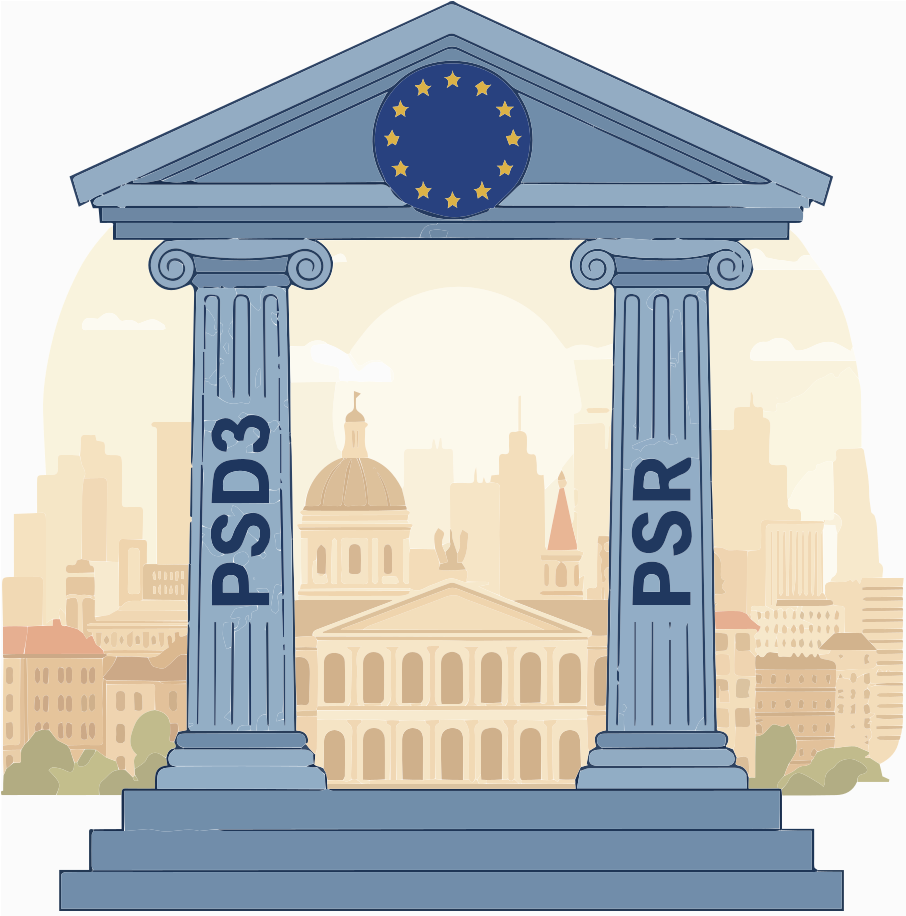
With the third Payment Services Directive 3 (PSD3) and the new Payment Services Regulation (PSR), the European Union aims to place the European payments market on a future-proof foundation. Unlike PSD2, the EU is now adopting a dual structure:
This marks a decisive step forward: national deviations and so-called “gold-plating” will largely be eliminated. Instead, a harmonised EU-wide framework will apply, creating fairer competition, fostering innovation and ensuring legal certainty.The reform package is not merely a response to the shortcomings of PSD2, but a fundamental realignment of the European payments market.
It clearly separates responsibilities between structure (Directive) and application (Regulation) – thereby strengthening the integrity of the Single Market.

With PSD3 and PSR, the EU is tightening requirements on security and transparency in payments. The goal is to strengthen consumer trust and make digital payments even more secure.
Explanation:
Strong Customer Authentication (SCA) will be further expanded and refined. Specific exemptions will be more clearly regulated, and requirements for accessible authentication procedures will increase. In addition, payment service providers will be required to provide more detailed information – for example on fees, currency conversions or payees.Stricter rules will also apply to pre-authorisations, such as at petrol stations or hotels, where blocked amounts will now be subject to clearer release requirements.
Action Required:

PSD3 addresses modern fraud schemes such as spoofing and social engineering much more rigorously. Institutions must implement new control mechanisms and collaborate more closely.
Explanation:
A central element is the mandatory verification of IBAN and beneficiary name in transfers to prevent manipulation. Institutions will also be required to enhance transaction monitoring and report anomalies at an early stage.The exchange of fraud data between payment service providers will be reinforced by regulation. In parallel, institutions will face greater obligations for customer education and staff training in fraud awareness.
Action Required:

A key element of PSD3 is the restructuring of the licensing regime. All payment institutions and e-money institutions will be required to renew their authorisation.
Explanation:
With PSD3, the previous E-Money Directive will be repealed and integrated into the new framework. Existing licences will no longer be valid. Institutions must undergo a new licensing process, which sets stricter requirements on governance, capital resources, outsourcing and IT security.The transition periods are tight – those who start early will gain a decisive time advantage.
Action Required:

PSD3 promotes greater competition by giving non-bank payment service providers easier access to essential banking services and payment systems.
Explanation:
In the past, banks often denied third-party providers access to accounts or payment systems. Under PSD3, banks will be required to clearly justify such decisions. Payment institutions will also have the right to appeal.This will reduce market entry barriers and foster innovation – particularly benefitting FinTechs and smaller providers.
Action Required:
The implementation of PSD3 and PSR follows a multi-stage roadmap. Even though the final texts are still under negotiation, a clear timeline is emerging:
Conclusion of EU trilogue negotiation
Publication in the Official Journal, PSR enters into force directly as a regulation (6 months after publication) and Member States transpose PSD3 into national law (typically 18–24 months deadline).
All payment and e-money institutions must comply with the new requirements and, where applicable, undergo re-licensing.
The coming years will be decisive for payment and e-money institutions. Those who prepare early will gain a competitive advantage.
To support you, we have compiled in-depth analyses, practice-oriented whitepapers and up-to-date articles on PSD3 and PSR.

Blog
More information
Whitepaper
More informationLet’s review together how you can put regulatory requirements into practice – efficiently and effectively
30 minutes for more clarity – book your appointmentFree & non-binding · 30 minutes · Remote

PSD3 (Payment Services Directive 3) is an EU directive that must be transposed into national law by member states. It primarily regulates licensing, supervision and institutional requirements for payment and e-money institutions. PSR (Payment Services Regulation) is an EU regulation that applies directly and uniformly in all Member States – without national implementation. It sets operational standards such as technical requirements, strong customer authentication (SCA), transparency obligations and fraud prevention. This dual structure prevents national deviations and creates genuine EU-wide harmonisation in payment transactions for the first time.
The expected timeline: A breakthrough was achieved in the EU trilogue negotiations in 2025. The PSD3/PSR are now expected to be published in the EU Official Journal in early 2026 and to enter into force in 2026 as well. The PSR, as a regulation, will enter into force directly, while Member States will have to transpose PSD3 into national law within 18-24 months, i.e. by around 2027. From 2027 onwards, all payment and e-money institutions will have to comply with the new requirements and renew their licences. Institutions should start preparing by 2025 at the latest, as re-licensing takes 8-14 months.
Yes. PSD3 repeals the previous E-Money Directive (EMD2) and integrates it fully into the new PSD3 framework. This means that all existing licences – both for payment institutions and e-money institutions – are no longer valid. All institutions must undergo a new licensing procedure with the competent national supervisory authority (in Germany: BaFin). The new requirements are significantly stricter: tighter governance, higher capital requirements, more comprehensive IT security, more detailed outsourcing documentation. There are transition periods (grandfathering), but no automatic extension.
Grandfathering refers to transitional arrangements that allow existing institutions to continue operating despite new requirements. Under PSD3, institutions with existing licences can generally continue to operate, but must apply for a new licence in accordance with PSD3 standards within the transition period. Typical deadlines: 18-24 months after national entry into force (i.e. approximately until 2028/2029). Important: Grandfathering is NOT a free pass – institutions must demonstrate that they are actively working on compliance. Those who miss the deadline will lose their licence. Recommendation: Start early (2025) with gap analysis and preparation.
All payment service providers within the scope of the PSD are affected: payment institutions under PSD3, e-money institutions (previously EMD2, now integrated into PSD3), account information service providers (AISPs), payment initiation service providers (PISPs), credit institutions (banks) involved in payment transactions, fintechs offering payment services, and providers of wallet and payment solutions. Also indirectly affected: IT service providers, cloud providers and outsourcing partners of these institutions, as stricter requirements apply to third-party relationships.
We are happy to offer you a free initial consultation
